Martin Herbert was my friend. He died in the early hours of yesterday morning. He died suddenly and unexpectedly. His death is a great shock to everyone who knew him.
Martin was my closest male friend from our University days: we studied at the University of Durham in the mid- to late-1970s. Like me, he was a thoughtful person, which is one of the reasons why we got on so well. We shared a taste in folk music. I talked at length with Martin when I first met the woman who would become my wife, and he attended our Quaker wedding many years later. It was Martin who aroused my interest in the Religious Society of Friends (Quakers).
However, unlike me, Martin was a talented amateur artist, and a gifted musician, both abilities that were to prove extremely significant in his life. I was familiar with his artworks while we were still students. Before he left Durham, Martin gave me one of his early, airbrushed acrylic works, the style of which was reminiscent of the work of Roger Dean, whose album covers were popular at the time. The painting has rarely been off a wall in whichever house I have lived in ever since.
Immediately after university, Martin was uncertain of his direction, and worked for a while as a 'theme park' station master at Beamish Museum in County Durham, in full uniform, replete with pocket watch. When I was turned down by the British Antarctic Survey (BAS), Martin applied and his application was successful. In my beat up Austin 1300, I drove Martin and his luggage to Cambridge, where the BAS is based, only to discover that we had left a suitcase in Durham, so we had to drive all the way back again the same evening. He worked as a meteorologist in the Antarctic for a couple of years.
At some stage Martin took a well-paid job with a major software company called the Santa Cruz Operation (SCO), relocating to High Wycombe in Buckinghamshire. During this time, he developed his talents to play every musical instrument (other than a ukulele) one can find in a folk club, and then also started to run the folk club. Martin and at least one of his folk groups (Wynters Armoury?) played at folk festivals such as that at Cambridge. My wife, daughter and I met him in Whitby when he was playing at the folk festival there. He bought a bothy on the North York Moors, but sold it again when he realised how rarely he was able to travel back north. I am unsure how many years he worked for SCO, but at some stage he decided that he'd had enough of all that, had saved enough money, and took himself off round the world for a year, often travelling off the beaten track, collecting ethnic musical instruments, and being taught to play them. On his return, inspired by some indigenous American music and instruments he had encountered (and bought), he played, synthesised, recorded and produced an album of wonderful haunting music that I have listened to a million times: Spirit of the Wood. My cassette tape of the music is nearly worn out, but it can still be found in mp3 format on his website (www.martinherbert.com).
Whilst I am hazy about dates, some while later Martin packed his fiddle and went south to Andalucia (he was familiar with Laurie Lee's book As I walked Out One Midsummer Morning) to live in the house of a friend. There he started to develop much further his abilities in fine art. I think that he was in Spain for a couple of years. From a Pre-Raphaelite interest in naiads and dryads as an amateur artist at university, Martin developed a much more robust new-age kind of spiritual artistic interest and style, combining traditional artistic skills with digital. He launched a website called Spirit Visions, and was able successfully to sell some of his work. Returning to Britain, he moved into a ramshackle house in mid-Wales, and I guess that he was in proximity to like-minded people. He married a Finnish artist, Vivi-Mari Carpelan, who seemed to give him a renewed zest for life. Galleries accepted his work for sale, and he was a serious entrant for national artistic competitions. For a while his weblog incorporated weekly a new artwork. A year or two ago, Martin decided that he would be able to make more headway in the competitive artistic world if he were to have an MA in Fine Art. This autumn he enrolled at Aberystwyth University. His energy and enthusiasm for the degree appeared boundless, and it would seem that his presence was welcomed by staff and students alike.
I consider it possible that Martin may have mellowed in middle-age compared with our student days, when he was a refreshingly uncouth young man from Peterlee, County Durham, although I believe that he was born in Derbyshire. I will never forget an evening in some pub or other, telling how, on a previous occasion, having drunk quite a lot of alcohol, he had vomited and then observed: "I don't remember eating that!" Martin always lived life a little faster and more richly than me. Artist, musician, more-recently a loving husband, a good friend to many, many people, and my most long-standing friend. You will be missed. I shall miss you.
Showing posts with label art. Show all posts
Showing posts with label art. Show all posts
11 December 2014


15 December 2010
Movie review: Still Walking, directed by Hirokazu Kore-eda
It is interesting reading other reviews for this movie, which demonstrate the possibility of experiencing the same thing so differently. Still Walking is 'a comedy of manners', reminiscent of the movies of Eric Rohmer. (Comedy as distinct from tragedy, not in the sense of being humorous.) Like a haiku, nothing is brightly coloured, overstated, or has the impoliteness to stand out in some way. Typical of Japanese etiquette, the characters rarely say or act on what they really mean, and this is revealed only as the story unfolds. Characterisation is superbly handled through script, direction and acting. Unlike in western movies, there are neither heroes/saints, nor dastards/demons. It would be too easy to watch this movie through western eyes and miss the subtle, the nuanced, and the quiet reversals that culminate in overall balance. In western culture it is held that the more deeply an emotion is felt, the more extremely it is expressed. However, the expression of emotions addressed in this Japanese drama is muted: it is possible to arrive by another route at a sense of how deeply those emotions are felt. The movie is perfectly paced for its material (not the high-octane outbursts of Who's Afraid of Virginia Woolf, or of Look Back in Anger), but may be considered intolerably slow by people who enjoy thrillers, adventure movies and rom coms. (Instead, think Tarkovsky.) Unlike a Woody Allen movie, Still Walking is not an easy watch, requiring concentration and attention, although neither is it especially difficult: the plot, such as it is, is interesting enough for me not to require it to entertain me cheaply (even though I enjoy the jokes in Wasabi). There is no feel-good pay-off at the end. There is no 'the end' (c.f. Lost in Translation). I do not know the other work of director Hirokazu Kore-eda, but I now feel motivated to find out more.
26 November 2010
2001: A Space Oddysey
I wrote the text below in response to a thread of comments regarding a brief, critical user review of the DVD 2001: A Space Oddysey.
I think that Anthony Costine's Rothko observation is valuable: for me, Mark Rothko's huge, nearly-formless canvases serve as the closest fine art is able to approach to a spiritual gateway - his works present me with the opportunity safely to stand on the threshold between life and death. The Clarke / Kubrick novel / screenplay (they wrote them together) considers the breathtaking enormity of the leaps made by humankind from our genetic divergence away from other primates. We are not really being invited to consider the detail of each technological development and innovation, but to gulp at the height of the cliff edge on which we now perch. The story then moves on to consider ways in which humankind may further develop, perhaps in ways that will seem god-like to the just-beyond-savages who we are today. 2001 is intended neither to be an intellectual movie, nor a thrill ride, nor a drama, no more than were one standing on the brink of the Grand Canyon, or sitting in front of a Mark Rothko painting, or watching a movie (such as Stalker) by Andrei Tarkovsky. Perhaps the 'mistake' is to consider it (along with Solaris by Andrei Tarkovsky) primarily as work of science fiction. Maybe the fact that Clarke was a science fiction writer, and the movie was marketed as science fiction misdirects how the movie can most engagingly be viewed.
I think that Anthony Costine's Rothko observation is valuable: for me, Mark Rothko's huge, nearly-formless canvases serve as the closest fine art is able to approach to a spiritual gateway - his works present me with the opportunity safely to stand on the threshold between life and death. The Clarke / Kubrick novel / screenplay (they wrote them together) considers the breathtaking enormity of the leaps made by humankind from our genetic divergence away from other primates. We are not really being invited to consider the detail of each technological development and innovation, but to gulp at the height of the cliff edge on which we now perch. The story then moves on to consider ways in which humankind may further develop, perhaps in ways that will seem god-like to the just-beyond-savages who we are today. 2001 is intended neither to be an intellectual movie, nor a thrill ride, nor a drama, no more than were one standing on the brink of the Grand Canyon, or sitting in front of a Mark Rothko painting, or watching a movie (such as Stalker) by Andrei Tarkovsky. Perhaps the 'mistake' is to consider it (along with Solaris by Andrei Tarkovsky) primarily as work of science fiction. Maybe the fact that Clarke was a science fiction writer, and the movie was marketed as science fiction misdirects how the movie can most engagingly be viewed.
15 December 2008
Come and See
I wrote the following in comment to a review on Amazon.co.uk regarding the Russian movie by Elem Klimov called Idi i smotri (Come and See). I have posted the comment here because I wish to develop a few ideas from it.
"Whilst what you have written may well be true, fair and balanced, Klimov's movie is intended only as true - it is you who place on it the burden of being fair and balanced. Whilst some art clearly does attempt to achieve balance, I am not sure that a painting such as 'Guernica' would be improved were it to attempt a panoptic perspective. Maybe a BBC documentary about the Second World War in Byelorussia would feel more satisfactory as accurate reporting and fair analysis."
"Whilst what you have written may well be true, fair and balanced, Klimov's movie is intended only as true - it is you who place on it the burden of being fair and balanced. Whilst some art clearly does attempt to achieve balance, I am not sure that a painting such as 'Guernica' would be improved were it to attempt a panoptic perspective. Maybe a BBC documentary about the Second World War in Byelorussia would feel more satisfactory as accurate reporting and fair analysis."
20 April 2008
Kaos (2): response and review
Superb. A masterpiece. A masterclass in arthouse movie making.
(There is so much to write that it will take me weeks to construct this weblog posting.)
Kaos is the name the Taviani brothers gave to this movie homage to the writings of Luigi Pirandello, partly because a corruption of the word is the name of the place where Pirandello was born, partly because chaos is what Pirandello feared: the void, the abyss, nothingness, desolation. The movie exudes nothingness in which the characters and actions exist. The nothingness is as tangible as the stones in the barren fields, and the rock on which the houses precariously perch. The roaring silence and blank canvas give a perspective that is almost intolerable in the twenty-first century. People are leaving for the United States every week because of the grinding poverty and the emptyness.
The movie is made up of several short stories, linked by landscape and culture. Reading some of Pirandello's short stories, it is easy to recognise that the Taviani brothers have translated them well from page to screen. The movie starts with a prologue that makes little cognitive sense, but introduces themes important to the movie, such as landscape, human purpose, narrative, the brutality of life, transcendence. The crow of this prologue, a bell round its neck, flies over the landscape between stories, providing a visual and auditory connection between episodes. The movie ends with a Pirandello short story about being called home to talk to his long-dead mother.
Little happens in any of the stories: Kaos is not an action movie. Neither is it a drama, or any other obvious and popular genre. However, tension does find resolution. Kaos reminds me of Tarkovsky's Stalker, and Kurosawa's Rashamon. The style of acting does not belong to Hollywood, it is much more theatrical (like Fiddler on the Roof), which seems fitting as Pirandello is best known as a playwright.
(There is so much to write that it will take me weeks to construct this weblog posting.)
Kaos is the name the Taviani brothers gave to this movie homage to the writings of Luigi Pirandello, partly because a corruption of the word is the name of the place where Pirandello was born, partly because chaos is what Pirandello feared: the void, the abyss, nothingness, desolation. The movie exudes nothingness in which the characters and actions exist. The nothingness is as tangible as the stones in the barren fields, and the rock on which the houses precariously perch. The roaring silence and blank canvas give a perspective that is almost intolerable in the twenty-first century. People are leaving for the United States every week because of the grinding poverty and the emptyness.
The movie is made up of several short stories, linked by landscape and culture. Reading some of Pirandello's short stories, it is easy to recognise that the Taviani brothers have translated them well from page to screen. The movie starts with a prologue that makes little cognitive sense, but introduces themes important to the movie, such as landscape, human purpose, narrative, the brutality of life, transcendence. The crow of this prologue, a bell round its neck, flies over the landscape between stories, providing a visual and auditory connection between episodes. The movie ends with a Pirandello short story about being called home to talk to his long-dead mother.
Little happens in any of the stories: Kaos is not an action movie. Neither is it a drama, or any other obvious and popular genre. However, tension does find resolution. Kaos reminds me of Tarkovsky's Stalker, and Kurosawa's Rashamon. The style of acting does not belong to Hollywood, it is much more theatrical (like Fiddler on the Roof), which seems fitting as Pirandello is best known as a playwright.
19 April 2008
Kaos (1): in anticipation
Kaos, produced and directed by the Taviani brothers, was released onto the theatrical art-house movie circuit in 1984. It was screened at the Tyneside Cinema, Newcastle, UK, in 1985, the single occasion when I watched the movie. It left such a deep and lasting impression that I have been searching for a copy of the movie since I bought my television and VCR in 1992. Over the years I have come across several copies of the VHS video for sale, but they have been in US television format (why does the US have to set every standard differently from the rest of the world? - for another posting) and extremely expensive. Being dogged, I have persisted in checking every few months (since about 1995) to discover whether any movie distribution companies had released Kaos for the British / European market, initially on VHS and more recently on DVD. Cliche warning: imagine my surprise a couple of weeks ago when a soon-to-be-released DVD suddenly appeared on the lists of several DVD suppliers. I was so taken aback that I wondered whether it was a scam. My copy was sent from White Rock, Arkansas, US. Excited to receive it as a child with a new toy, I shall watch it this evening.
In telling my story to people I know, few seem as surprised as I am not that the movie should be released on DVD, but that in the face of steadfast evidence to the contrary, I should continue to stand sentinel for the release of this movie on DVD. Thirteen years is a long time to wait. Only a few people know that I waited a long time for Godfrey Regio's Koyaanisqatsi trilogy to be released on DVD. Even fewer know that I am still waiting for Steppenwolf (based on the novel by Hermann Hesse) and Le Grandes Meulnes (based on the novel by Alain Fournier) to be released on DVD. In telling my story, I am saying something important about who I am.
Instead, what almost everyone I have told has focused on is how I shall react watching a movie for only the second time in 23 years, and in particular a movie I have built up in my mind as being so special that it was worth checking the listings of newly-released videos every few months. In part, I have felt mildly irritated that the focus of my story, about dogged, optimistic persistence, has been dismissed and replaced with a focus on whether the movie will live up to my expectations. In part, I have felt disappointed that the people who I have told (all British) assume that I may feel disappointed with the movie. I have also felt a little sad that no-one much has expressed any interest in watching the movie - I know only one or two people who come anywhere near matching my movie taste.
What will it be like? There are scenes and aspects from the movie that I recall vividly: bandits playing boules with the severed heads of their victims; a man howling at moon as he believes he is transformed into a werewolf; an urn-mender who realises that he is trapped in the urn he has just mended; the absence of someone who has recently died. The movie works at a visceral level that I would term expressionist. The issues addressed are profound and concern existence, and I would term this existentialist. The movies that I know which address such issues belong to such directors as Andrei Tarkovsky, Akira Kurosawa, Ingmar Bergman and Peter Greenaway.
What will it be like? I shall watch the movie with a more experienced eye, mind and heart than before. Half my life has passed since I first watched the movie. I have changed in many ways, and expect that the movie, as though a mirror, will reflect an image of my young adult self. Will the middle-aged adult I have become respond to and appreciate the movie as fully as the young adult I was? Who knows? I shall have to find out, and accept what I experience.
What will it be like? I have written elsewhere about having an interest only in those movies that are worth watching at least several times. I trust that Kaos is a movie so rich in difficult ideas that I shall watch it many times. I already know that its initial heady flavours of wormwood and jasmine, citrus and woodsmoke, give way to a complex aftertaste that lingers for decades. I am looking forward to seeing masters of cinema at work.
In telling my story to people I know, few seem as surprised as I am not that the movie should be released on DVD, but that in the face of steadfast evidence to the contrary, I should continue to stand sentinel for the release of this movie on DVD. Thirteen years is a long time to wait. Only a few people know that I waited a long time for Godfrey Regio's Koyaanisqatsi trilogy to be released on DVD. Even fewer know that I am still waiting for Steppenwolf (based on the novel by Hermann Hesse) and Le Grandes Meulnes (based on the novel by Alain Fournier) to be released on DVD. In telling my story, I am saying something important about who I am.
Instead, what almost everyone I have told has focused on is how I shall react watching a movie for only the second time in 23 years, and in particular a movie I have built up in my mind as being so special that it was worth checking the listings of newly-released videos every few months. In part, I have felt mildly irritated that the focus of my story, about dogged, optimistic persistence, has been dismissed and replaced with a focus on whether the movie will live up to my expectations. In part, I have felt disappointed that the people who I have told (all British) assume that I may feel disappointed with the movie. I have also felt a little sad that no-one much has expressed any interest in watching the movie - I know only one or two people who come anywhere near matching my movie taste.
What will it be like? There are scenes and aspects from the movie that I recall vividly: bandits playing boules with the severed heads of their victims; a man howling at moon as he believes he is transformed into a werewolf; an urn-mender who realises that he is trapped in the urn he has just mended; the absence of someone who has recently died. The movie works at a visceral level that I would term expressionist. The issues addressed are profound and concern existence, and I would term this existentialist. The movies that I know which address such issues belong to such directors as Andrei Tarkovsky, Akira Kurosawa, Ingmar Bergman and Peter Greenaway.
What will it be like? I shall watch the movie with a more experienced eye, mind and heart than before. Half my life has passed since I first watched the movie. I have changed in many ways, and expect that the movie, as though a mirror, will reflect an image of my young adult self. Will the middle-aged adult I have become respond to and appreciate the movie as fully as the young adult I was? Who knows? I shall have to find out, and accept what I experience.
What will it be like? I have written elsewhere about having an interest only in those movies that are worth watching at least several times. I trust that Kaos is a movie so rich in difficult ideas that I shall watch it many times. I already know that its initial heady flavours of wormwood and jasmine, citrus and woodsmoke, give way to a complex aftertaste that lingers for decades. I am looking forward to seeing masters of cinema at work.
29 December 2007
Nationhood (1): Fiddler on the Roof
I recently watched a television broadcast of Norman Jewison's 1971 movie Fiddler on the Roof. I have the VHS video, which I have watched several times, and I am wondering whether to buy the DVD. I often watch on television movies that I have on video. Not only is the quality of the broadcast picture superior - we have a Freeview digibox (digital television signal) box - but the inability to pause and rewind, which I do a lot in order to reflect on what I am watching, much to the mounting annoyance of my wife and daughter - we do not have TiVo - gives the viewing experience an edginess that whilst usually less intellectually satisfying, with the inevitable risk of disengagement between awareness and an integrated cognitive/conative/affective and imaginal response, can be emotionally more gratifying.
I was concerned, having watched the movie for the nth time, to discover what some of the critics have written about it. Roger Ebert was mildly scathing, whereas others have been more generous, although generous is probably what they intended. I find it helpful to read critics' reviews because they inevitably confirm some of my own thoughts and responses, and suggest others that had not occurred to me. I do not fully trust my own judgment. Most obviously for me, a good movie is one that I wish to watch many times. I feel cheated if the movie is not worth watching more than once. For this reason I rarely watch made-for-television movies. I am also likely to feel cheated if the only differences between the first and second viewings are that I know the plot twists and the denouement. On this basis I have learned that I have little interest in watching Ocean's Xteen. I was intrigued to find out whether I would find watching Memento as satisfying for the second time. The jury is still out on whether I should buy the DVD (the issue of memory is important to me). At the other end of the spectrum, the movies I like best are one's that, every time, take me on a journey, if I am up for it, into an even deeper understanding of what it is for me to be human in this world. This is what makes the movies of Andrei Tarkovsky, Akira Kurosawa, Peter Greenaway and Godfrey Regio so compelling for me, and also why I have a fascination for dystopias. In a 'good movie' there will always be the opportunity to discover more. Sometimes this involves seeing/hearing more clearly. My best analogue for this concerns a CD of music by Peter Maxwell Davies. I did not 'understand' what I was listening to the first time I heard it. The dissonances sounded like a cacophony, and the broken rhythms sounded like chaos. Only from many repeated playings have I come to hear the beauty and poise, accompanied by a progressive appreciation of his music. I care what critics write about Peter Maxwell Davies, or about Tarkovsky, Kurosawa, Greenaway or Regio, because I wish to 'understand' more. I am not required to agree with the evaluations of critics. A case in point is the movie I Heart Huckabees. I took the movie at face value albeit on three levels: 1) the level of plot / story / entertainment, etc.; 2) the movie-making level - script, acting, characterisation, filming, editing, etc.; 3) a philosophical level. On the first two of these levels the movie is terrible, and nothing on earth would induce me to watch it again. However, on the philosophical level the movie has something to say, and I shall watch it again. Naturally the critics slammed the movie. I also discovered from the reviews is that the movie is considered to be a spoof, the director intentionally mocking intellectual movies. Maybe, therefore, unlike the Peter Maxwell Davies CD, the movie has little so say - a second viewing and I shall be done with it - maybe. The idea of an existential detective agency interests me, even if the director intended it as a joke.
What does Fiddler on the Roof offer me in repeated viewings? There are major issues of personal, social and national identity, of cultural tradition ("Tradition"), and of spirituality. During the most recent viewing I felt challenged by the concept of personal, cultural and spiritual identity determining national identity. I like the globalised world in which we now live, and the breakdown of a one-to-one mapping between cultural and spiritual identity on the one hand and nationality (whether it be where I live or what is written in my passport) on the other. Whilst I understand something about Israel and about Kosovo, I also understand something about early twentieth century Japan, about Nazi Germany, about Afghanistan's Taleban, about aspects of Putin's Russia. I applaud the European Union both for its programme of smudging the statehood of nations, and for its support of cultural and spiritual diversity. These kinds of articulated insights are gold dust. I wonder what Fiddler on the Roof will offer me next time.
I was concerned, having watched the movie for the nth time, to discover what some of the critics have written about it. Roger Ebert was mildly scathing, whereas others have been more generous, although generous is probably what they intended. I find it helpful to read critics' reviews because they inevitably confirm some of my own thoughts and responses, and suggest others that had not occurred to me. I do not fully trust my own judgment. Most obviously for me, a good movie is one that I wish to watch many times. I feel cheated if the movie is not worth watching more than once. For this reason I rarely watch made-for-television movies. I am also likely to feel cheated if the only differences between the first and second viewings are that I know the plot twists and the denouement. On this basis I have learned that I have little interest in watching Ocean's Xteen. I was intrigued to find out whether I would find watching Memento as satisfying for the second time. The jury is still out on whether I should buy the DVD (the issue of memory is important to me). At the other end of the spectrum, the movies I like best are one's that, every time, take me on a journey, if I am up for it, into an even deeper understanding of what it is for me to be human in this world. This is what makes the movies of Andrei Tarkovsky, Akira Kurosawa, Peter Greenaway and Godfrey Regio so compelling for me, and also why I have a fascination for dystopias. In a 'good movie' there will always be the opportunity to discover more. Sometimes this involves seeing/hearing more clearly. My best analogue for this concerns a CD of music by Peter Maxwell Davies. I did not 'understand' what I was listening to the first time I heard it. The dissonances sounded like a cacophony, and the broken rhythms sounded like chaos. Only from many repeated playings have I come to hear the beauty and poise, accompanied by a progressive appreciation of his music. I care what critics write about Peter Maxwell Davies, or about Tarkovsky, Kurosawa, Greenaway or Regio, because I wish to 'understand' more. I am not required to agree with the evaluations of critics. A case in point is the movie I Heart Huckabees. I took the movie at face value albeit on three levels: 1) the level of plot / story / entertainment, etc.; 2) the movie-making level - script, acting, characterisation, filming, editing, etc.; 3) a philosophical level. On the first two of these levels the movie is terrible, and nothing on earth would induce me to watch it again. However, on the philosophical level the movie has something to say, and I shall watch it again. Naturally the critics slammed the movie. I also discovered from the reviews is that the movie is considered to be a spoof, the director intentionally mocking intellectual movies. Maybe, therefore, unlike the Peter Maxwell Davies CD, the movie has little so say - a second viewing and I shall be done with it - maybe. The idea of an existential detective agency interests me, even if the director intended it as a joke.
What does Fiddler on the Roof offer me in repeated viewings? There are major issues of personal, social and national identity, of cultural tradition ("Tradition"), and of spirituality. During the most recent viewing I felt challenged by the concept of personal, cultural and spiritual identity determining national identity. I like the globalised world in which we now live, and the breakdown of a one-to-one mapping between cultural and spiritual identity on the one hand and nationality (whether it be where I live or what is written in my passport) on the other. Whilst I understand something about Israel and about Kosovo, I also understand something about early twentieth century Japan, about Nazi Germany, about Afghanistan's Taleban, about aspects of Putin's Russia. I applaud the European Union both for its programme of smudging the statehood of nations, and for its support of cultural and spiritual diversity. These kinds of articulated insights are gold dust. I wonder what Fiddler on the Roof will offer me next time.
16 April 2007
Lila, by Robert Pirsig
There are few people who have not read Robert Pirsig's principal claim to fame: Zen and the Art of Motorcycle Maintenance. That I have read the book twice is not saying much. Even if some people have a copy on their bookshelves only for show, never having read the novel, that proportion must be small compared with the number of people who posess a copy of A Brief History of Time by Professor Stephen Hawking, although the pages of the book are as yet uncut. I doubt, however, that there is kudos associated with either owning or reading a copy of Pirsig's Lila, a sequel in several senses to Zen and the Art of Motorcycle Maintenance.
Lila uses a similar formula to Zen and the Art of Motorcycle Maintenance: a 'road trip' story interspersed with the advancement of a philosophical model of human experience.
On the positive side I found many valuable insights in Pirsig's text, the most illuminating being:
However, I feel suspicious about philosophy being presented inj the format of a novel. Despite the existentialists, such as Jean-Paul Sartre, Albert Camus and Friedrich Durenmat having presented and explored, or at least illustrated, their ideas in a fictional format (novels, novellas, short stories and theatrical plays), and probably being most popularly known for this, I question why someone who purports to have something new and substantial to say would choose a medium that requires the suspension of disbelief and literary sleights of hand, and would risk the message being ignored or thrown out because the literary quality of the work may be considered to be poor. The literary works of Sartre, Camus and Durenmat may not all be masterpieces, but they can be read at least adequately, and in many cases exceptionally well, without being required to engage with the philosophical exposition. Susan Hill's novels, such as In the Springtime of the Year, The Bird of Night, and I'm the King of the Castle, are typically each important psychological explorations that work well as novels. In none is Hill breaking new and contentious ground, and with each it would be possible to visit source material, for example with the novels listed: respectively bereavement, psychotic breakdown and sibling rivalry. I would feel uneasy were I to find that Hill was, in fact, presenting new, unsupported ideas about psychology and psychiatry through the medium of a novel.
[to be continued...]
Lila uses a similar formula to Zen and the Art of Motorcycle Maintenance: a 'road trip' story interspersed with the advancement of a philosophical model of human experience.
On the positive side I found many valuable insights in Pirsig's text, the most illuminating being:
"If objects are the ultimate reality then there's only one true intellectual construction of things: that which corresponds to the objective world. But if truth is defined as a high-quality set of intellectual value patterns, then insanity can be defined as just a low quality set of intellectual value patterns, and you get a whole different picture of it."When the culture asks, 'Why doesn't this person see things the way we do?' you can answer that he doesn't see them because he doesn't value them. He's gone into illegal value patterns because the illegal patterns resolve value conflicts that the culture's unable to handle. The causes of insanity may be all kinds of things, from chemical imbalances to social conflicts. But insanity has solved these conflicts with illegal patterns which appear to be of a higher quality."
However, I feel suspicious about philosophy being presented inj the format of a novel. Despite the existentialists, such as Jean-Paul Sartre, Albert Camus and Friedrich Durenmat having presented and explored, or at least illustrated, their ideas in a fictional format (novels, novellas, short stories and theatrical plays), and probably being most popularly known for this, I question why someone who purports to have something new and substantial to say would choose a medium that requires the suspension of disbelief and literary sleights of hand, and would risk the message being ignored or thrown out because the literary quality of the work may be considered to be poor. The literary works of Sartre, Camus and Durenmat may not all be masterpieces, but they can be read at least adequately, and in many cases exceptionally well, without being required to engage with the philosophical exposition. Susan Hill's novels, such as In the Springtime of the Year, The Bird of Night, and I'm the King of the Castle, are typically each important psychological explorations that work well as novels. In none is Hill breaking new and contentious ground, and with each it would be possible to visit source material, for example with the novels listed: respectively bereavement, psychotic breakdown and sibling rivalry. I would feel uneasy were I to find that Hill was, in fact, presenting new, unsupported ideas about psychology and psychiatry through the medium of a novel.
[to be continued...]
26 March 2007
Middlesbrough Institute of Modern Art: MIMA
Middlesbrough Institute of Modern Art (MIMA) is a new art gallery housed in a recently-completed building set in a magnificent square in the heart of Middlebrough town centre. The gallery cost £14.1 million, and the square £5.5 million. These are signiifcant sums of money for a town that carries an unremitting industrial reputation to spend on fine art and architecture.
I visited the gallery on a cold, breezy day in March, bright with sunlight, and was able to photograph both the gallery itself and some of the other buildings around the square. Photography of the inside of the building is permitted, but not of exhibitions. To view my photographs, follow this link:
Middlesbrough Institute of Modern Art
From the outside, and contrasted with the other buildings in the square, this grand building looks fittingly like a modern art gallery. Its box-like structure, somewhat reminiscent of Walsall's new art gallery, feels modern and contructed. Whilst the two side walls and the back wall are made of a glowing white material that could be limestone, conrete or rendered breeze blocks, the wall overlooking the square is mostly an immense expanse of glass recessed behind vertical steel cables. The main entrance is at the front of the building towards the right. Beside the main entrance, part of the wall is built from am ordered chaos of limestone blocks with all manner of different dressings. From this I took a message that paying attention to detail will yield results. This wall departed from the concept of minimal decoration and large flat areas. It also appeared immediately obvious that thought and attention have been given to the materials of which the building is made.
With its grand atrium from which all floors are visible but activities are hidden. the inside of the building feels a little like the inside of the Sage in Gateshead. The dark stone tiled floor feels pleasingly lavish. To the immediate right of the main entrance a tasteful cafe/restaurant occupies the right end of the ground floor. A staircase with wooden (oak?) bannister climbs diagonally from left to right in a barely-broken run from ground floor to third floor.
[Give details of the gallery spaces.]
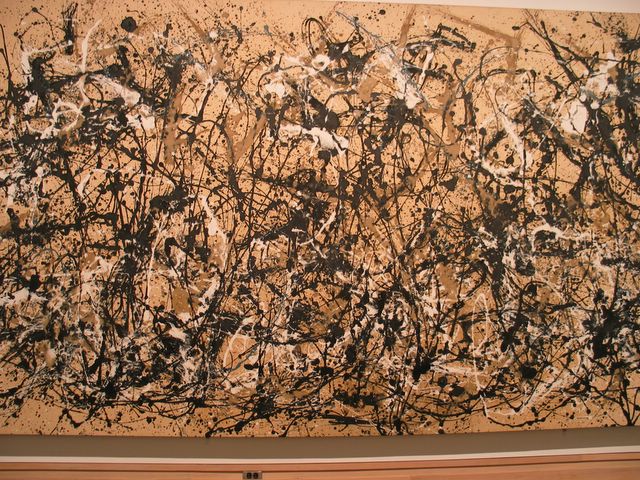
On the day of my visit there was an exhibition of drawings in a variety of media. Most notable was the fact that there were a few works by some big names: Picasso, Pollock. The value of the exhibition, however, was the work of less-well-known artists [give details]. Perhaps one of my shortgcomings is that I value examining the drawings of an artist only once I am familiar with their work. I was disappointed not to view some of the paintings in the gallery's permanent collection. With this purpose in mind I intend to visit the gallery again soon.
[Give details of the square]
[Upload photographs of the square]
In summary, I visited Middlesbrough in order to see, examine and photograph a building, and also to view an exhibition. Although the exhibition did little for me, the building is very obviously a significant and valuable addition to the architecture of Middlesbrough town centre.
I visited the gallery on a cold, breezy day in March, bright with sunlight, and was able to photograph both the gallery itself and some of the other buildings around the square. Photography of the inside of the building is permitted, but not of exhibitions. To view my photographs, follow this link:
Middlesbrough Institute of Modern Art
From the outside, and contrasted with the other buildings in the square, this grand building looks fittingly like a modern art gallery. Its box-like structure, somewhat reminiscent of Walsall's new art gallery, feels modern and contructed. Whilst the two side walls and the back wall are made of a glowing white material that could be limestone, conrete or rendered breeze blocks, the wall overlooking the square is mostly an immense expanse of glass recessed behind vertical steel cables. The main entrance is at the front of the building towards the right. Beside the main entrance, part of the wall is built from am ordered chaos of limestone blocks with all manner of different dressings. From this I took a message that paying attention to detail will yield results. This wall departed from the concept of minimal decoration and large flat areas. It also appeared immediately obvious that thought and attention have been given to the materials of which the building is made.
With its grand atrium from which all floors are visible but activities are hidden. the inside of the building feels a little like the inside of the Sage in Gateshead. The dark stone tiled floor feels pleasingly lavish. To the immediate right of the main entrance a tasteful cafe/restaurant occupies the right end of the ground floor. A staircase with wooden (oak?) bannister climbs diagonally from left to right in a barely-broken run from ground floor to third floor.
[Give details of the gallery spaces.]
On the day of my visit there was an exhibition of drawings in a variety of media. Most notable was the fact that there were a few works by some big names: Picasso, Pollock. The value of the exhibition, however, was the work of less-well-known artists [give details]. Perhaps one of my shortgcomings is that I value examining the drawings of an artist only once I am familiar with their work. I was disappointed not to view some of the paintings in the gallery's permanent collection. With this purpose in mind I intend to visit the gallery again soon.
[Give details of the square]
[Upload photographs of the square]
In summary, I visited Middlesbrough in order to see, examine and photograph a building, and also to view an exhibition. Although the exhibition did little for me, the building is very obviously a significant and valuable addition to the architecture of Middlesbrough town centre.
10 May 2005

Subscribe to:
Posts (Atom)

