Some people appear to consider long life to be a significant virtue. I consider long life to be a weak virtue, inasmuch as I can be of value to people who need me. Compared to a shorter life, a longer life, to me, principally provides greater opportunity to engage in whatever I consider to be virtuous. The people featured in the National Geographical article (November 2005) are leading lives that I would consider unspeakably boring: a shepherd in Sardinia, a woman living in some non-entity place in Japan, a Seventh Day Adventist woman in California. The lives of the people are characterised by a cultural conservatism circumscribed by a narrow geographical range. Whilst the article makes something of the diets of each of the people, contrasting it with a fast-food lifestyle, the message I take from it is about avoiding living life to the full. If travel and meeting a wide range of people shortens my life a little, I am willing to accept that cost, for the alternative would feel much more costly to me.
30 October 2005
National Geographical article on longevity


Online, on-demand programmes
I bought my first television in 1993, and although it has been reapired several times, I have not yet needed to replace it. Over the intervening twelve years I have slipped into the habit of watching Question Time and This Week (current affairs), Grand Designs and other property development programmes, and programmes about relocating one's home to the countryside or elsewhere in the world. However, the televison programme I came to watch with near-religious fervour was BBC 2's Newsnight. I used to drink it like I drank my first cup of tea in a morning. I now rarely watch the programme. Instead I receive a daily newsletter from the Newsnight team, and can catch the programme online. I like to be able to watch the parts of the programme that interest me, and to skip whatever sends me to sleep. I like to be able to watch the articles I want to watch when convenient for me. As well as matters of interest and convenience, I still have a desire to avoid conforming to some grand scheduling scheme. I hope that the recent announcement by the BBC to extend the online availability of more of their programmes heralds a rapid expansion of online, on demand viewing.
Halloween carnival
There is, for me, something disturbing and unhealthy about revelry swirling around concepts of death and evil. In most instances, death involves loved ones, loss, pain and difficult transitions. The prospect of my own death is a key factor in how I chose to live my life. I miss my father, who died in 1992. I still recall vividly my pain and sadness at the death of the family pet dog in the 1960s, and the violent sobs of my daughter when her pet hamster died. Evil is what murdered Anne Frank and millions of Jewish people. Evil stalked the streets of Kosovo and the villages of Rwanda and Burundi, and still visits refugee camps in Darfur. I have no enthusiasm to celebrate death and evil.
Maybe the Halloween carnival is a response to the fear that people feel about cancer, bird 'flu, war, terrorist bombs and airliner crashes. Making jokes about death, and laughing at evil, may be coping strategies for some people. There are also traditions, elsewhere in the world, such occasions as the Mexican 'Day of the Dead', that acknowledges the importance, sadness and irrevocability of death. Easter (technically Good Friday) appears to be a sober acknowledgment of the fundamental existential importance of death, even though it is also overlaid with Christian dogma. These examples seem valuable.
To be continued ...
23 September 2005
New job
Having been out of work for several months, everything in my life had progressively slowed down. I was on holiday in sultry south west France for two and a half weeks during August. On returning to the UK, I would watch movies on video until one or two in the morning, and then sleep in until eight, breakfast, shower, read any mail, and then prepare lunch. After lunch, if I felt energetic I might go for a walk, or go shopping. Otherwise I would read a book until dozing off until it was time to prepare the evening meal. The rest of the evening would be spent watching television, then a movie, and the cycle would have restarted. Sounds like retirement: pleasant enough, but pointless, without direction, and living on borrowed.
Already one gear up, the pace of life is faster and, thankfully, continuing to accelerate. Work is important to me. Work provides me with part of my identity without which I start to fade. I am meeting and getting involved with people new to me. I am encountering people whose need can be addressed through my competence.
[To be continued]
04 August 2005
Tall Ships, Newcastle-Gateshead
This view shows the Millennium Bridge framing the Sage (concert hall and music conservatoire). In the background can be seen the famous Tyne Bridge.
0002.jpg)
Unline the "London Eye" on the south bank of the River Thames, I don't believe that the ferris wheel (that I heard being referred to as "the eye") in Millennium Square in front of the Baltic Art Gallery is a permanent fixture.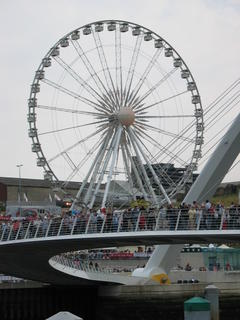
The colourful-looking wooden ship is a Russian vessel named Shtandart. After it set sail for Norway, the weather was so bad that it had to return to Newcastle-Gateshead.
0004.jpg)
This shows a typical riverside scene, with tall ships berthed for as far as the eye could see. Visitors were two or three deep, and it was almost impossible to get alongside the railings to take this photograph.
0006_r1.jpg) The BBC producer with whom I was involved making the Video Nation short film about my daughter, Jemima, spent a day out in the North Sea on board the Trepidacious, which was moored a little way downstream.
The BBC producer with whom I was involved making the Video Nation short film about my daughter, Jemima, spent a day out in the North Sea on board the Trepidacious, which was moored a little way downstream.
I regret that I should have been seasick within minutes of stepping aboard. Very different from my uncle, in Canada, who spent many years in the British navy, and in the mid-1960s emigrated from Britain to Canada on board an ocean liner. I must find out its name.
BBC Video Nation short film
http://www.bbc.co.uk/tyne/videonation/stories/jemima.shtml
is a peep-hole through which to glimpse some aspects of my daughter's life. The film was edited by Andrew Jeffrey, a producer at the BBC in Newcastle. Andrew also offered guidance, gave encouragement, shot some of the film at Jemima's school, provided a stock photograph of Alan Shearer, obtained relevant permissions, and wrote the online text. He was a pleasure.
I have, until now, resisted all requests to allow online images of Jemima, for fear that such images may be used by unscrupulous people for dishonourable purposes. I gave much thought to the video images that were to be used in the short film. This has set me thinking about how to portray other aspects of her life and experience. I feel enthusiastic to make a longer film.
20 May 2005
About my father and his death
I wonder what it was like on that doubtless cold, probably miserable, January day, seventy years ago. How frightening it must have been for Rene to give birth to her first child having little certainty about how the baby was to be supported.
***
Aged 48 years, my father had his first heart attack in January 1984. It very nearly killed him. A year or two before he had bought a small, unexceptional terraced house, in which he was now living, in Enfield, north London, UK. He had recently started in a new, though somewhat menial, office job in nearby Palmer's Green. He remarried in spring 1983, at a civil ceremony in Liskeard, Cornwall, UK, at which I was a witness. Anne Stevenson wrote them a wedding poem that was subsequently published in The Times. Their first, her second, his third, daughter was born in December 1983. That first heart attack was also the start of his life.
My father's final, fatal heart attack struck some eight years later, when he was aged 56. He was now living in an attractive, stone-built cottage that he and his wife had bought and renovated on the edge of Bodmin Moor in Cornwall. He was working as a counsellor and counselling trainer; he was reading and writing a lot; he was able to spend time walking on Bodmin Moor, time learning about the local history and natural history of eastern Cornwall, time on his small-holding, time raising his daughter. During those eight years, he lived more, and more richly, in ways that were meaningful to him, than he had been able to live in the preceding 48 years. He had become interested and interesting, someone who had something to say, someone I could relate to. On the one hand it seems to me desperately sad that six sevenths of his life were dirt-poor, unfulfilling or deeply unhappy, and often all three. On the other hand I am thankful that he was able eventually to find happiness, and also that it was the final stage of his life that was the most enjoyable, fulfilling and personally rewarding for him.
He died on a Monday morning. His death was sudden and unexpected. Whilst his health since the first heart attack had required management, the triple-bypass operation had been successful. He had an ischaemic heart attack in 1991, and was subsequently subjected to hospital tests ("testing to destruction" he called it - I wonder if he was, in fact, correct). However, to all appearances, he could have lived a further ten years.
I was teaching at the time, and received a telephone call informing me of his death. For some reason I was not surprised. My co-tutor assumed responsibility for the class as I prepared to leave. I drove home, packed a few things, and set off for Cornwall: 400 miles, door-to-door. Several abiding images: sitting alone in a motorway service station drinking a mug of coffee, thinking about the bleak telephone call that told me of his first heart attack eight years before; an empty neon-lit motorway at midnight swooping down into Bristol; the narrow country lanes of eastern Cornwall, always so full of primroses and promise, now devoid of meaning, their sole and barren purpose to lead me to my father's dead body. It was something after two in the morning when I arrived.
I spent time with him, alone, reflecting on my experience of his life, my experience of my life with him, this experience of sitting in a room with the dead body of my father, this experience of sitting in a room with a dead body. His body had been laid on the bed, a loving, if practical, gesture, about which there was something calming, and amplified by the apparent peacefulness of his repose. I should have found it disturbing had his body shown indications of pain. I never doubted that he was dead, even though I expected to. His body looked lifeless, in the same way that the engine of a car recovered from having been swept out to sea is far beyond any hope of repair. His body appeared separated from life, like a spacewalking astronaut whose umbilical was accidentally, catastrophically, severed. I could see that my father was now beyond my reach, further receding as each moment passed. Although I debated the issue this way and that, I had no desire to touch his body for I was clear that I wished that my last and lasting memory of his physical presence should not be one that was cold and alien, but instead was visually warm and homely. Not everyone is offered my advantage of choice, and I remain sure, and thankful, that I made the right decision for me, about him, at that time.
We held a public funeral for him in Bodmin one morning the following week, playing tapes of music meaningful to him, such as from Mahler's Das Lied von der Erde. A huge number of people were in attendance, almost all from his life since his move to Cornwall after his first heart attack. In the afternoon we held a more intimate gathering in the tea rooms at Lanhydroc. His body had been cremated, and we scattered his ashes in places that had become important to him: up on the moors, and in the local woods and rivers. Each event involved acknowledging and accepting the reality of his death and embracing the pain of loss. I realise now that inevitable tectonic movement was taking place in the dynamics of family relationships, for since his life had restarted my father had become the hub connecting people. Without him the old model would no longer function. I was also at a watershed in my comprehension of him as a person: no longer able to check things out with him, no longer able to interact with him, in the main all that I shall ever understand about him is already within me. I have spent the past twelve years slowly getting to know what kind of a person he was and what kind of a life he led, both before and after that first heart attack.
Now that I am entering that same age-window, I cannot help but be aware that the ages at which he had his various heart attacks seem so young, premature, and frighteningly close-to-hand.
10 May 2005
08 May 2005
Modern icons (1)
In a computer-related context, the term icon has largely come to mean a cartoon-like picture. In a classical sense, it seems to me, that an icon is both a shorthand for something, and also a memory prompt for a category of experiences. I guess that classical icons work on both a publicly shared and a private level.
The Eiffel Tower in Paris and the Statue of Liberty in New York City are equally iconic, albeit regarding slightly different sets of experiences. Both are monuments that have come to symbolise both their location and some important aspect of social identity. The Eiffel Tower stands proudly for French engineering prowess and for the energy of nineteenth century France. It is a national symbol that was captured by a military enemy, and now represents the liberation of Paris from Nazi domination. It has become a symbolic mannequin to be clothed in the current Parisian and French national celebrations. The Statue of Liberty stands proudly for New York City as a tourist destination (contrast this with the New York City of Midnight Cowboy, and Bringing out the Dead); for new opportunities in a new world (see the opening credits of the Mike Nichols movie Working Girl); freedom from the oppression of racist and fascist Europe; a symbol of the US to be protected from terrorist attack.
The clock tower (housing Big Ben) in the Palace of Westminster represents London (as a tourist destination and cultural capital), the UK government (both as a seat of democracy, and as a repository of power with colonial resonances and domination over provincial UK), Britain as a tourist destination. Interestingly, Nelson's Column, in Trafalgar Square, carries a similar iconic load, but familiarity with it declines rapidly outside the south east of England. In contrast, the Millennium Wheel (London Eye) on the south bank of the River Thames in London is gradually achieving iconic status, and its recreational nature may carry the weight of tourist meaning more easily than 'Big Ben'.
[Addendum] Some weeks after first posting this, I came across a short article on the BBC News website about the status of the Millennium Wheel. The article (The history of the London Eye by Alexis Akwagyiram) goes at least some way to concurring with some of my thoughts expressed here.
Standing in the heart of the city, the Brandenburg Gate is an icon of Berlin. To a lesser extent it is also an icon of the German people, although this honour is shared with the Reichstag. Standing between the former East Berlin and West Berlin, the gate also points to the former existence of socialist East Germany, and to the contrasting vibrancy of the capitalist enclave of West Berlin, and to the Iron Curtain. The Brandenburg Gate has come to represent a German nation unified, and freed from communist occupation. However, whilst I am willing to extend that sense of liberation from communist occupation to occupation by the Nazi regime, I am unsure about the extent to which the gate was used as a national icon by the Nazis. In contrast, there is no ambiguity about the Eiffel Tower in Paris: Nazi occupation followed by French liberation.
The desert pyramids are an icon of Egypt. Images of the pyramids are used to encourage tourism by pointing to past Egyptian civilisation and historical culture. Contemporary Egypt is impoverished, resulting in some unpleasant political undercurrents that have made tourists into targets.
I wonder how iconic The Angel of the North has become. It is a massive sculpture by the British sculptor Anthony Gormley, and stands on high ground at the southern edge of Gateshead, Tyne and Wear, overlooking the A1 (the road that links London to Edinburgh). Some people from the North East England have taken it to heart, and for them it has come to stand for their identity as Geordies. However, for many people in the North East, it is far too modern, and far too high cultured. Moreover, its 'Tyneside' location is taken as exclusive by many people of Wearside (Makkems) and Teesside.
26 April 2005
The Death Clock is ticking
As a non-smoking male, who is only a bit overweight, my life expectancy is about 73 years. Barring accident and major illness, I have 25 years of life left in me. Were I a woman, I would live longer. Were I to smoke or gain weight, I would die sooner.
I was disappointed that, according to the Death Clock, there is nothing I can do to lengthen my allotted three score years and thirteen, other than (I suppose) submit myself to a sex change operation. I should have thought that my strictly vegan diet, whilst not limited to rice and lentils, ought to count for something in time credits. That I have for the time being given up drinking alcohol (supposedly for a Lent detox: I have been dry now since the end of January 2005) would suggest I deserved the addition of an extra year or two to my quota, but I read somewhere (or more likely heard it on the radio) that people who drink no alcohol live shorter lives than people who drink in spinster-restrained moderation. According to the Death Clock, losing weight would make a difference only were I to weigh more than I currently weigh.
I guess that the Death Clock algorithm (calculation) is based on insurance tables. I wonder how country-specific it is. Does it include statistics from parts of the world that are economically under-developed, where life expectancy is shorter than in the west? Assuming that the Death Clock makes its calculations from data drawn from within and beyond the US, I guess that it averages out regional variations that led to shorter life-spans, say, in Karelia (Finland) and Glasgow (Scotland). The Death Clock takes no specific account of inherited illnesses and genetic legacies; diet and exercise (other than their impact on body weight - in Karelia, whilst the lumberjacks were very fit, their high-dairy diet was packed so full of saturated fats that they died young of heart attacks caused by clogged arteries); or of compromised heath and safety at work. Obviously I am taking the Death Clock more seriously than the purpose for which it was intended.
How, then, should I respond to the Death Clock? Several thoughts occur. First, regardless of its accuracy regarding my own lifespan, the Death Clock is ticking, and at some point in the future my pockets will be empty of coins with which to feed the meter. Game over. I should like to explore the meaning of 'game over' on another occasion. The consequence, however, is that, as the seconds of my life tick away, I have perpetual opportunity to determine how to live my life. This is not to suggest that I am 'free to do anything I like'. It is, however, to suggest that I can re-evaluate my priorities and do more of my choosing. I should like to explore this on another occasion.
Second, despite its apparent bluntness as a predictive tool, the Death Clock serves as a reminder that my health and well-being are my responsibility that I can choose to accept or deny as I wish. There is much that I know about my health, and I often choose to act on this knowledge (for instance, I eat lots of fruit and vegetables; I have intentionally reduced my body weight; I have, for the time being, cut out drinking alcohol). However, I also make choices that are based on ignorance (for instance, I have only just found out that Teflon-type coatings are carcinogenic) or self-deception (for instance, I know that I ought to exercise much more than I do; I know that fried food is significantly less healthy than raw or boiled food, and yet I tell myself that it is not too bad; I still eat far too much salt). I should like to explore this on another occasion.
Third, whilst it may appear self-evident in 21st century western society that I should wish to maximise the length of my life, my preference is for my quality of life to remain high. I am not keen on the prospect of years of terminal decline (physical, cognitive, emotional and spiritual) into a low-quality, meaningless existence serving neither myself nor anybody else. I should like to explore several issue around this on another occasion.
Game over
I recently watched a movie (Random Hearts, starring Harrison Ford and Kristin Scott-Thomas) in which an airliner flying from Washington to Miami crashes into the sea. The people on board are killed, their existence suddenly, unexpectedly, prematurely extinguished. Their game was over: no more moves to make, no more sights to drink in, no more food to savour, no more music to enjoy, no more hopes and expectations, no more love. (To be continued ...)
23 April 2005
Question Time, BBC TV (2)
Waiting here is like waiting in an airport departure lounge for the announcement that signals the start of boarding . The 150 or so passengers are crowded into the upper bar area of the theatre. We range in age from mid-teens to mid-sixties; dress, grooming and accent signal social status (working class and middle class); there are lots of students, as well as housewives and businessmen; but we are almost exclusively white. David Dimbleby said that there are more men than women, but I can't say that the disparity is particularly noticeable. Prior to his pep talk we were busy. People were busy greeting friends; busy writing proposed questions onto cards; busy munching (non-vegan) sandwiches; busy swigging glasses of orange juice as though the drink contained vodka. A distressingly high proportion standing out on the balcony polluting the wonderfully golden evening air with foul tobacco smoke. Alone and hungry, I felt isolated as I sipped my instant coffee and devised cunning questions.
While he was talking, holding us in rapt attention, I wondered how such an alert man coped with delivering, week after week, polished, efficient, competent warm-up lines to crowds of weakly or selectively informed people who know only how to grind axes and bang drums. I enjoy being in the presence of a person who is informed, or a person with insight. I recall workshops with the poet Jon Silkin that left me feeling as though fire were running through my arteries.
Now there is expectation and apprehension. It is time to enter the studio-cum-auditorium. Cables lie draped and strewn like vines in a jungle. Television cameras the size of velociraptors come to life.
Whose questions will be chosen? A name is read out, and the person asked to identify themselves. A quip. Another person. Another quip. Down the list. Surely there is still space for my question. And then my name. No-one’s bothered, except that it feels like a chasm has opened around me. I leave my jacket on the bench seat and climb self-consciously down the stairs, joining the others whose questions have been selected.
In fact, my question was never requested. I felt bitterly disappointed, because I really wanted the question to be asked, as well as being given the opportunity to ask it. The issue remains live for me even today. However, I did get to make an 'audience comment' that was gently derogatory towards the Tories regarding their cynical whipping up of suspicion about so-called 'bogus asylum seekers'.
... to be continued...
21 April 2005
Question Time, BBC TV
15 April 2005
Doing stuff in the night
15 April 2005: Doing stuff in the night
It is about four in the dark well of the night. The world around me is asleep. Being April, the sky will be lightless, and the ground will remain in darkness, for some hours. I can hear rain slapping against the windows. A wintery wind is whipping the newly-budded trees in the garden. I feel unsettled and restless. I need paid work. I am also uneasy about being awake. I have been up, doing stuff (tidying, cleaning, housekeeping my e-mail) for the past couple of hours. I get anxiety attacks, adrenaline rushes, but not panic attacks - that is a path important for me to avoid. I wish I could cope more easily with change. Gizzajob. My services are no longer required at the place where I have been working for the past four years. I am being let go, made redundant, sacked. I was doing okay, but am now surplus to requirements. As a consequence I feel demoralised and depressed. Go on, gizzajob. The date on which my counselling work was to have ended passed a fortnight ago. The new people have been selected, appointed, and are currently being negotiated with. I have been allowed to stay on until the new people start work. I feel rather pathetic. Gizzajob. I have no firm plans, no leads, no irons in the fire, nothing in the pipeline. My chess pieces are not in a fighting formation, and I have been racking my brain to calculate how to move my king out of check. Do I look for a similar kind of job to the one that I have had for the past four years, or should I try to build up a portfolio of part-time contracts? At what stage do I decide that I have no option but to apply to work the telephone lines in a call centre or stack shelves in a supermarket? I have been scouring the job advertisements for some indication that I am employable, but the words in the advertisements seem not to register, as though written in some foreign script. Kind souls have recruited themselves to support me in my job quest, keeping their eyes peeled for job vacancies. In the meantime, I am sliding inexorably towards the lip of an abyss. However, despite my obvious awareness of the situation, along with being awake half the night, I also appear to be in denial, and cannot take in the horrific reality that the ground is just about to give way to empty space.08 March 2005
Skilled?
07:30 Tuesday 8 March 2005, home: Skilled?
07 March 2005
Is this free-fall?
7 March 2005: Is this free-fall?
Last Thursday (3 March 2005) I realised that I shall be out of work at the end of the month, with no identifiable prospects. Until then, I had not grasped that my work, counselling for the City of Sunderland, was over. Whilst I knew last year that the work I have been doing for the past four years would put out to tender, I was told not to worry, that I would be looked after. I had understood that the work was to be restructured. I knew in January 2005 that details of the tender were to be made available in mid- to late February 2005, and was told that the apprehension I expressed was misplaced. I was prepared for less favourable conditions. However, looking at the tender details for the first time last Thursday evening, I saw that the tender is geared solely towards medium and large businesses to supply the workers, and not towards sole traders. I am now extremely worried. I have not one shred of hope of being able to complete the documentation: the level of complexity is way beyond anything imaginable. On reflection, it feels as though I have been strung along for month after month. I should have been looking for alternative work. If only I had known. I feel bitterly disappointed, and betrayed by people I trusted. To whom do I look now? Where do I turn? How can I find work? I have a family and a mortgage. I need an income, a living, but do not know how to start the process of finding suitable work. I feel as though my confidence and competence have been drained from me. I feel disempowered. As I woke this morning, I knew immediately and instinctively that I am in danger of sinking into a depression. To be precise, it feels like I am in the process of stumbling over the edge of a cliff. Everything is in slow motion. The solid ground on which I was standing is now moving away. I am falling into a void. "Ladies and gentlemen, please fasten your seat belts. We shall encounter some turbulence as we enter free fall."05 March 2005

Singel in Springtime. I took several photographs of the Singel canal behind the hotel in which we were staying on Spui. I loved the intensity of the colours; the sense that Spring had just crept in overnight, under the cover of darkness; and the stillness of the scene, which is reflected in the stillness of the water.


Kroller Muller sculpture garden near Apeldoorn. The Kroller Muller museum at Hoghe Velouw [check spelling] near Apeldoorn in the eastern Netherlands, is one of the most rewarding art galleries and sculpture gardens I have ever visited. In particular, the gallery houses a substantial collection of works of art by Vincent van Gogh in which it is possible to experience van Gogh's compassion, his exuberance and his ability that I have always taken for granted when viewing his most famous works of art displayed in various national galleries. The Kroller Muller has other collections too, including sculptural works by such artists as Giacometti, as well as staging exhibitions. The scupture garden is both important and a delight to walk round (including with a camera!). Unmissable.

Springtime at Keukenhof Gardens. I first heard about this World Heritage Site when most of my family of origin visited it early in the 1970s. I had thought that it would be just a load of flowering bulbs. It is, in fact, one of the most beautiful places in the world in Springtime, and I am a richer person for having visited.


0003_r1.jpg)
0007_r1.jpg)